 Questions? (888) 869-0898 · assuritytesting.com
Questions? (888) 869-0898 · assuritytesting.com
Questions? (888) 869-0898 · assuritytesting.com
Every rule in Part 395 — not a highlight reel. The 14-hour window that never pauses, the split-sleeper rule almost everyone gets wrong, and the log habits that turn into an Unsatisfactory safety rating. Under two hours, for drivers and the office.
Refunds within 5 business days of purchase: 100% if not started, 75% if under 10% viewed, 50% if under 30% viewed. Instant certificate. See refund policy
Refunds within 5 business days of purchase: 100% if not started, 75% if under 10% viewed, 50% if under 30% viewed. Instant certificate. See refund policy
This isn't a scare tactic. It's arithmetic straight out of the regulation.
Appendix B to 49 CFR Part 385 defines a pattern of critical-regulation noncompliance as more than one violation — and where documents are reviewed, at least 10% of those examined. Pull 100 logs, find 10 bad ones. That's a pattern.
A pattern normally scores 1 point. But Appendix B assesses 2 points for a pattern in Part 395 — hours of service is the only part of the FMCSRs with a doubled value.
Two points in a rating factor is an Unsatisfactory factor rating. So a single HOS pattern takes your Operational factor from Satisfactory straight to Unsatisfactory — no stop in between. Nothing else in the regulations does that.
And under § 385.13, an Unsatisfactory rating generally prohibits you from operating — beginning the 46th day for hazmat and passenger carriers, the 61st for everyone else. Module 8 shows you the weekly audit that keeps you well clear of it.
Property- and passenger-carrying CMV drivers who want to run legal — and stop giving away hours the rules actually allow them. Includes the split-sleeper and short-haul flexibilities most drivers under-use.
Module 8 is built for the office: a repeatable weekly log audit, the audit trail an investigator asks for first, and how to correct a driver so the paperwork helps you instead of indicting you.
Most HOS violations are created at the dispatch desk before the truck moves. Learn to plan against the clocks — and why § 390.6 puts you personally in the frame for coercion.
Every module ends with a quiz. 80% to advance, unlimited retakes. Plus a bonus module for safety managers that doesn't count against your drivers' clock.
Who's covered under the § 390.5 CMV definition, interstate vs. intrastate, and what a violation actually costs — including the Part 385 rating math.
What § 395.2 really counts as "on duty," detention and waiting time, and the three clocks — including which statuses don't stop the 14.
10 off, 11 driving, the 14-hour window, and the 30-minute break — plus a worked legal day and the different passenger-carrying numbers.
60/70, the rolling recap, the 34-hour restart, and the split taught as the rule it actually is — not the two options everyone misquotes.
Adverse driving conditions, the 150 air-mile short-haul exception, the 16-hour day, and personal conveyance vs. yard moves.
Who must use one, form and manner, certifying, edits and unassigned driving, malfunctions, roadside transfer, and supporting documents.
§ 395.13 out-of-service, falsification and ELD tampering, how auditors catch it, the Part 385 rating math, and the coercion rule.
The weekly log audit, the audit trail, correcting a driver, dispatching legally, and what's actually coming from FMCSA. Optional — drivers can skip it.
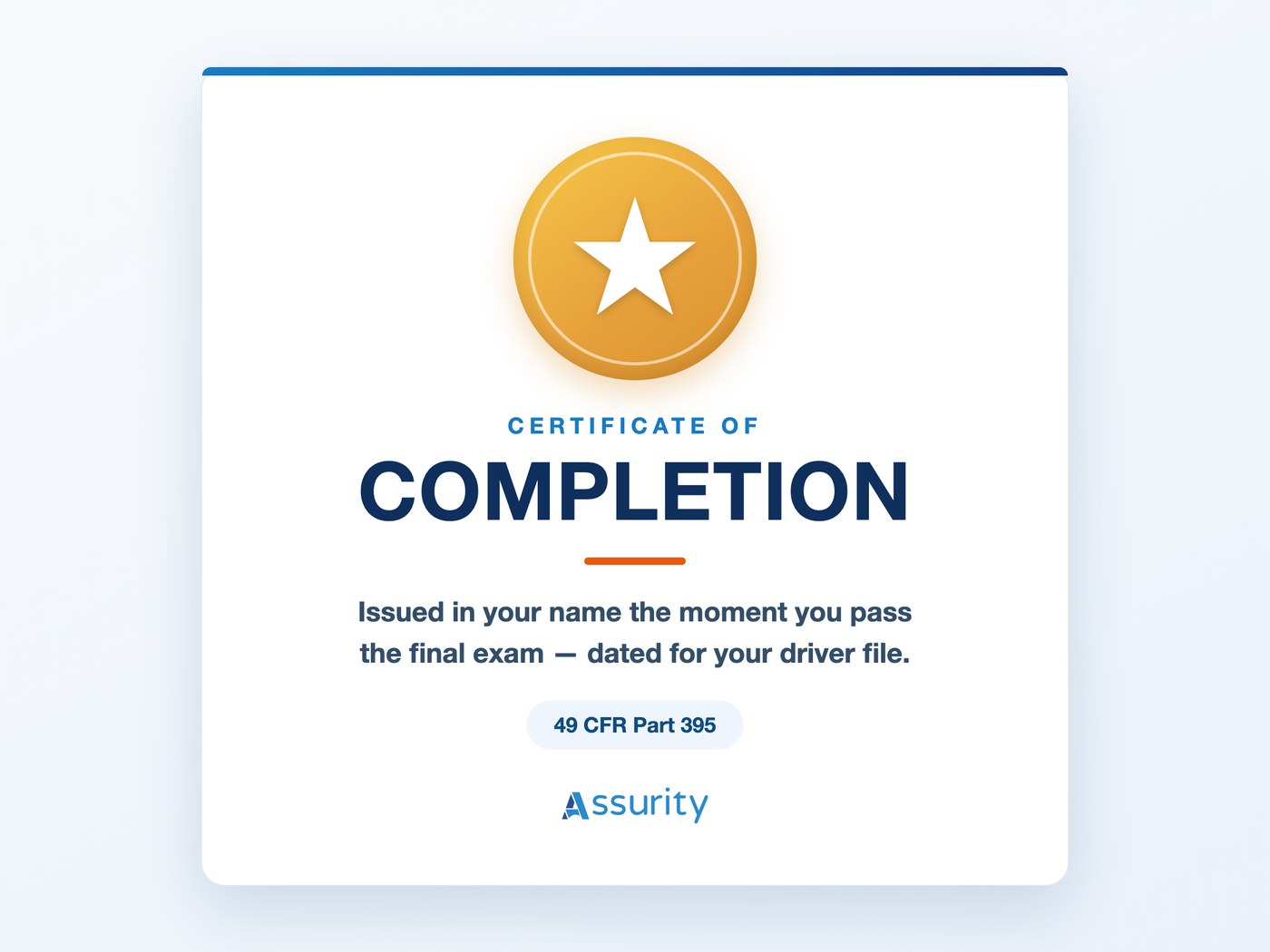
Finish the final exam and your dated certificate issues immediately, citing 49 CFR Part 395. File it in the driver qualification file — it's where an investigator looks first.
What this certificate is: a training record documenting instruction under 49 CFR § 390.3(e), which requires that every driver and employee involved in motor carrier operations be instructed regarding the regulations.
Pay once. You're in immediately — no scheduling, no waiting for a class date.
Eight modules at your own pace, on any device. Stop and resume anywhere.
12 questions, 80% to pass, unlimited retakes. Focus on learning, not guessing.
Dated and downloadable the moment you pass, plus both printable downloads.
No — and we won't tell you otherwise. 49 CFR Part 395 contains no training mandate. What does exist is § 390.3(e), which requires that drivers and employees involved in motor carrier operations be instructed regarding the regulations, and that employers know and comply with them. This course is how a carrier meets and documents that duty. If you see an HOS course advertised as federally mandated, Part 395 is the place to check — the mandate is not there.
No. Hours of Service is a required theory topic under the ELDT rule, but Assurity is not a registered ELDT provider and this course does not substitute for ELDT or count toward it.
No. Nothing removes a valid violation from your record. What training does is stop you generating new ones — and give your carrier documented management controls if it's ever investigated.
The federal clocks govern interstate commerce — which is determined by the freight's journey, not whether your truck crosses a state line. Intrastate-only operations follow their state's rules, which vary. Lesson 1.4 covers the three patterns states use and tells you to verify with your state agency. We deliberately don't print any single state's numbers, because they'd be wrong somewhere else.
Yes, and we check rather than assume. Every rule, number, and citation was verified line-by-line against the current eCFR text of Parts 385, 386, 390, and 395. The course deliberately flags several widely repeated industry beliefs that are simply wrong — including the ELD document requirement that changed in June 2026, and the FMCSA flexibility pilot programs that are not law and that drivers are already misapplying.
Yes. Call us and we'll set up fleet pricing and enroll your roster — (888) 869-0898.
Under two hours for the core seven modules, including the final exam — in line with the industry standard, and they can stop and resume anywhere. The safety-manager module is separate and optional, so it doesn't come out of a driver's day. If you're budgeting payroll for a fleet rollout, use two hours per driver.
Lifetime. Come back any time the rules get fuzzy — and there's no mandated federal refresh cycle for HOS, though we recommend an annual refresher and training at hire as company policy.
Request a refund in writing within five business days of purchase and you get a full refund if you have not accessed the course, 75% back if you have viewed less than 10% of it, or 50% back if you have viewed less than 30%. See our full refund policy for the details.
Seven modules · under 2 hours · dated certificate · bonus manager module
Refunds within 5 business days of purchase: 100% if not started, 75% if under 10% viewed, 50% if under 30% viewed. Instant certificate. See refund policy
Buying for a fleet? Call (888) 869-0898.
Self-paced online courses with quizzes and a dated certificate.
49 CFR § 382.603 · $39.99
49 CFR Part 40 & 382 · $115
49 CFR § 40.33 · from $99
Both courses, two certificates · $139